Macedonia
 English
 Deutsch
US Heavy-Duty EV Charging Infrastructure: Building the Backbone for Electric Freight
Друго |
2025-11-03 12:08:12
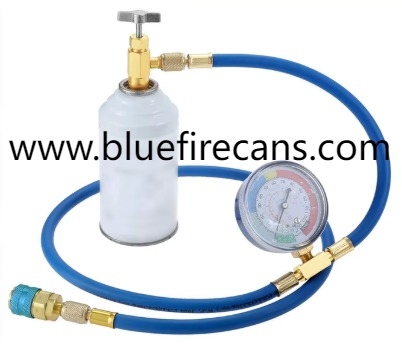
When a service technician lifts a can to top up a system, the gauge on the can provides immediate clues that guide careful decisions. An R134a Refrigerant Can fitted with a clear, accurate pressure gauge helps technicians judge whether the charge is suitable for the ambient conditions, whether the container has retained integrity during storage, and whether the system being serviced will accept the refrigerant without added risk. The pressure reading is an on the spot diagnostic that connects supply handling to system health.
Pressure reflects temperature and concentration in straightforward ways. A reading within the expected working band for the can under local conditions suggests the gas was handled and stored properly and that the container valve likely sealed during transit. If the gauge reads unexpectedly low or high for the environment, it prompts a pause: was the can exposed to adverse storage, was the valve damaged in handling, or has the can been partially dispensed and returned to inventory? Those questions matter because unseen contamination or moisture entry often accompanies leaks and poor sealing behavior.
For technicians, the gauge is a quick quality check before hooking up service hoses. It is practical to combine that visual check with an assessment of the can's exterior and of the valve cap. A can that shows denting, cap movement, or a pressure reading that does not match ambient conditions invites more careful handling. Taking an extra moment to verify can condition prevents mistaken assumptions about the contents and reduces the chance of injecting compromised product into a sensitive compressor circuit.
Beyond storage concerns, the gauge also helps with safe handling when systems sit in different thermal conditions. Refrigerant pressure responds to temperature, and the gauge gives an immediate indicator of whether the charge trajectory will be stable once introduced into a closed circuit. For systems that operate in widely varying climates or that face heavy load, confirming the can pressure before charging reduces guesswork and supports a controlled filling process that respects equipment tolerances and lubricant behavior.
Diagnostics benefit because a pure and properly handled refrigerant tends to produce predictable pressure temperature relationships. If a technician observes a pressure anomaly on the can while the system's service manifold reports unexpected readings, the combined information helps isolate whether the issue starts with the can, with residual contamination in the lines, or with an internal system fault. In short, the gauge shortens the path from observation to diagnosis and makes subsequent tests more targeted.
Field safety is another dimension where the gauge plays a preventive role. Abnormal pressure readings can indicate compromised valves or substandard filling procedures. A container that exhibits instability under normal ambient conditions could vent unexpectedly or behave unpredictably when connected, elevating risk to staff and bystanders. Seeing that signal up front allows technicians to quarantine suspect units and to follow safer handling procedures, instead of assuming the can is safe to use.
Supply chain transparency ties into the gauge story as well. Suppliers that fit cans with reliable gauges and that maintain records showing how units were stored and tested provide buyers with practical confidence. When procurement teams require visible handling information and batch identification, the presence of a functioning gauge on the can becomes part of a broader quality assurance regime that supports traceability and reduces the scope of corrective action in the event of an incident.
Routine training amplifies the gauge's value. When technicians are taught to interpret gauge readings in the context of ambient temperature, machine loads and recent transport conditions, the tool moves from a simple indicator to a diagnostic instrument. Training that includes examples of what to do when readings deviate — from rejecting a can to performing supplemental checks — improves both safety and efficiency at service points.
Maintenance workflows benefit too. Technicians who check the can gauge before use reduce rework and warranty exposures because they avoid introducing suspect refrigerant into systems that then display vague symptoms. Rework often costs more in labor and downtime than the preventive step of rejecting an anomalous can and sourcing a vetted replacement. That practical economy matters for small shops as well as for larger service fleets.
Regulatory attention and market conversations about refrigerant handling have placed greater emphasis on documentation and visible evidence of proper storage. A gauge that corroborates a supplier's handling claims makes it easier to demonstrate due diligence to a regulator, a retail partner, or a large customer. When suppliers combine accessible pressure indication with documented production and handling notes, they help customers meet compliance expectations without extensive additional testing.
For fleet managers and procurement professionals the gauge is a tool that supports smarter purchasing. When choosing suppliers, request can samples and inspect the gauge behavior across typical shipping and storage profiles. Evaluate how gauges respond to temperature swings and whether they remain accurate after transit. Those checks are practical because they reveal how units will behave in the field and because they reduce surprises that arise from cans that change pressure unexpectedly between warehouse and service bench.
Finally, innovation in packaging and monitoring is making gauges more informative. Some suppliers now pair visible pressure indication with batch identifiers and with simple handling recommendations printed nearby, turning a gauge into part of a compact information system. That integration reduces error at the point of use and helps technicians make decisions that protect compressors and systems alike.
When care is taken at the supply, handling, and service stages, a gauge on an R134a Refrigerant Can becomes a vital ally for technicians and buyers. It links storage conditions to system outcomes, improves diagnosis, and supports safer handling choices that protect compressors from avoidable harm. For product specifications, valve options and supplier handling guidance visit https://www.bluefirecans.com/ .